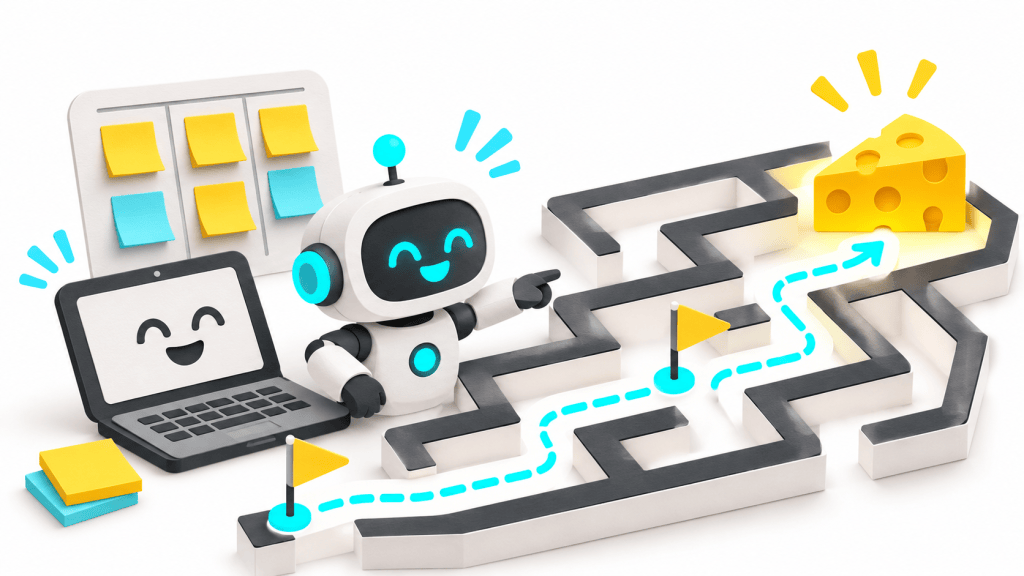
Imagine this: your squad gets a new team member.
They’re available whenever you need them, can suggest code, help with test scenarios, and draft requirements in seconds.
Sounds great, right?
There’s just one thing. They can also be confidently wrong, miss important context, and forget to mention that they made something up.
Meet your new squad member: AI.
So, is AI eating our cheese?
After reading Who Moved My Cheese? and exploring Out of the Maze, I started thinking about how software teams respond to AI.
The “cheese” can represent the skills and ways of working we depend on. The “maze” can represent the beliefs that shape how we see our options.
And AI is certainly making us question both.
A developer might wonder what happens to their craft when code can be generated in seconds. A tester might ask what their role looks like when AI suggests test cases. An Agile practitioner might wonder whether an agent can do some of their work.
These are fair questions. We’ve spent years building our skills, and change can feel personal.
But what if we also asked:
How can AI support our squad while we continue to bring our experience and judgment?
Give AI a role, not the final word
Think of AI as a team member who can help you get started, explore ideas, and spot things you may have missed. But like any contribution to the team, its work needs discussion and review.
For example:
- A developer can ask AI to suggest an implementation, then review it for security, maintainability, and fit with the product.
- A tester can use AI to generate possible scenarios, then add the context and curiosity needed to find the gaps.
- A Product Owner can use AI to draft a user story, then work with the squad to challenge assumptions and clarify the outcome.
- An Agile practitioner can use AI to organize retrospective themes, while paying attention to the people and conversations behind them.
AI can contribute. The squad remains accountable for what it delivers.
And just like we wouldn’t give a new joiner access to everything on their first day, we need to use approved tools and be thoughtful about the information we share.
Does your new squad member improve the flow?
Let’s say AI helps a developer finish code faster. Great! But the code then waits days for review and testing.
Our new squad member may be quick, but the customer is still waiting.
That’s why we need to look at the whole journey from idea to value. Where is work getting stuck? Could AI help the squad prepare test scenarios earlier or understand a dependency? And does reviewing its output take more effort than it saves?
More output is easy to celebrate. Better flow and useful outcomes are what we’re really looking for.
Time for a squad experiment
You don’t need to redesign the whole team around AI by next Tuesday.
Choose one story and invite AI to help with one activity. For example, ask an approved tool to suggest test scenarios. Then have the developer and tester review them together.
At the retrospective, ask:
- What did AI help us see or do?
- What did it miss or get wrong?
- Did it help the team, or create more work?
- What would we do differently next time?
That’s Agile in action: try something small, learn together, and adapt.
So, is AI eating your cheese? Maybe it has just joined the squad and is waiting for a useful task.
How is your team working with its newest squad member?


Leave a Reply