Have you ever seen a team get excited about a shiny new AI tool and just… start using it?
No plan. No thinking. Just vibes and automation.
Yeah… I have seen this happen more than once.
And then suddenly:
- AI output is all over the place
- No one really trusts it
- And somehow… things feel more complicated, not less
Funny, right?
Here is the thing; AI is not magic.
And plugging it into your team without thinking it through is a bit like adding a new Scrum ceremony just because you saw it somewhere.
Looks productive.
Feels modern.
But… is it actually helping?
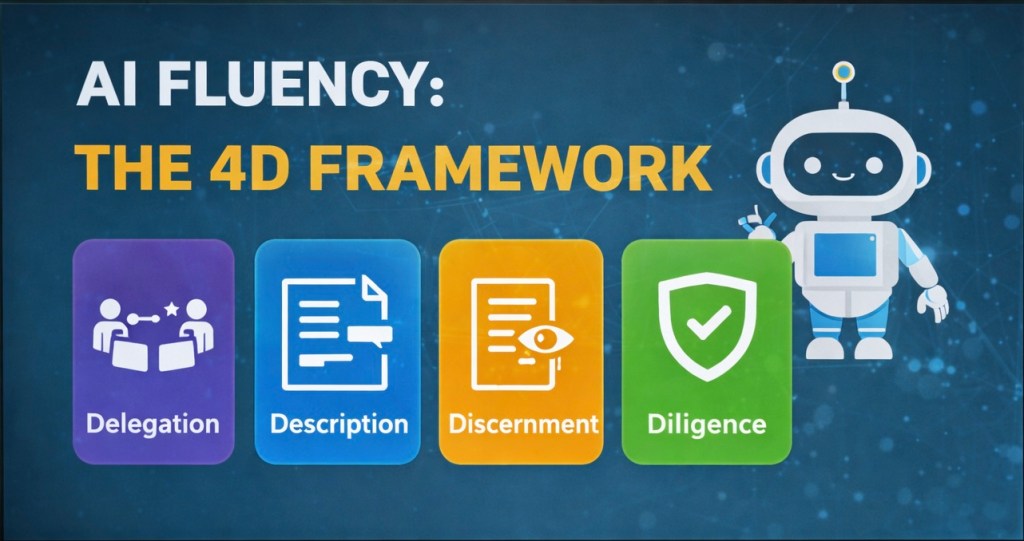
Recently, I came across something called the 4D Framework for AI Fluency.
And honestly? It clicked immediately.
Because it’s not about the tool itself.
It’s about how we think while using it.
Before your team jumps on the AI train, there are four simple (but powerful) things to think about.
First: Who Should Actually Be Doing This Task?
This is Delegation and we already do this in Agile.
We don’t just throw work randomly. We think about:
- Who’s best suited?
- What needs human thinking?
- What can be automated?
AI is no different.
Before you automate something, ask yourself:
- Does this need judgment, empathy, or context?
- Or is it repetitive and structured enough for AI?
A retrospective? Definitely human.
A first draft of a user story? AI can help a lot.
The mistake is going to extremes everything AI or nothing AI.
Second: Can You Actually Describe What You Want?
This is Description and honestly… this is where things usually break.
You know those user stories that say:
“As a user, I want to do things better”
Same thing with AI.
If you don’t know what good output looks like, AI will not magically figure it out for you.
The teams that get real value from AI are usually the ones already good at:
- Clear thinking
- Clear requirements
- Clear expectations
So if your team already writes solid user stories…
You are ahead here.
If not… well, now you have another reason to fix that.
Third: Can You Tell When the Output Is Actually Good?
This is Discernment and this is the game changer.
AI can sound very confident… and still be wrong.
We don’t:
- Merge unreviewed code
- Accept unclear backlog items
So why would we trust AI output without thinking?
Your role doesn’t disappear with AI it becomes more important:
- Does this make sense?
- Is it accurate?
- Is anything missing?
Think of it like a mini Sprint Review… but for AI output.
Inspect. Adapt. Always.
Fourth: Are You Being Thoughtful About How You Use It?
This is Diligence and honestly, this is the one most teams skip.
Because it’s not about speed… it’s about responsibility.
- Are we sharing sensitive data?
- Are we over-relying on AI?
- Are we transparent about its usage?
Using AI responsibly isn’t about slowing down.
It’s about being intentional.
And if you think about it… that’s just Agile again.
So before your team adopts AI…
Try this quick AI Readiness Check:
- Delegate → What are we giving to AI (and why)?
- Describe → Do we know what “good output” looks like?
- Discern → Who checks the output before it is used?
- Diligence → Are we using AI responsibly?
Can’t answer these?
You’re not ready yet; and that’s okay.
Inspect. Adapt. Then try again.
Final thought
AI isn’t the problem.
Rushing into it without thinking is.
The teams that will get the most value aren’t the fastest adopters.
They are the ones who treat AI like any other teammate:
- With clarity
- With feedback
- With intention
Sound familiar?
Yeah… that’s just being Agile.
Over to you
Have you adopted AI on your team yet?
Did you think it through or just dive in and figure it out later?
I would love to hear your experience


Leave a Reply