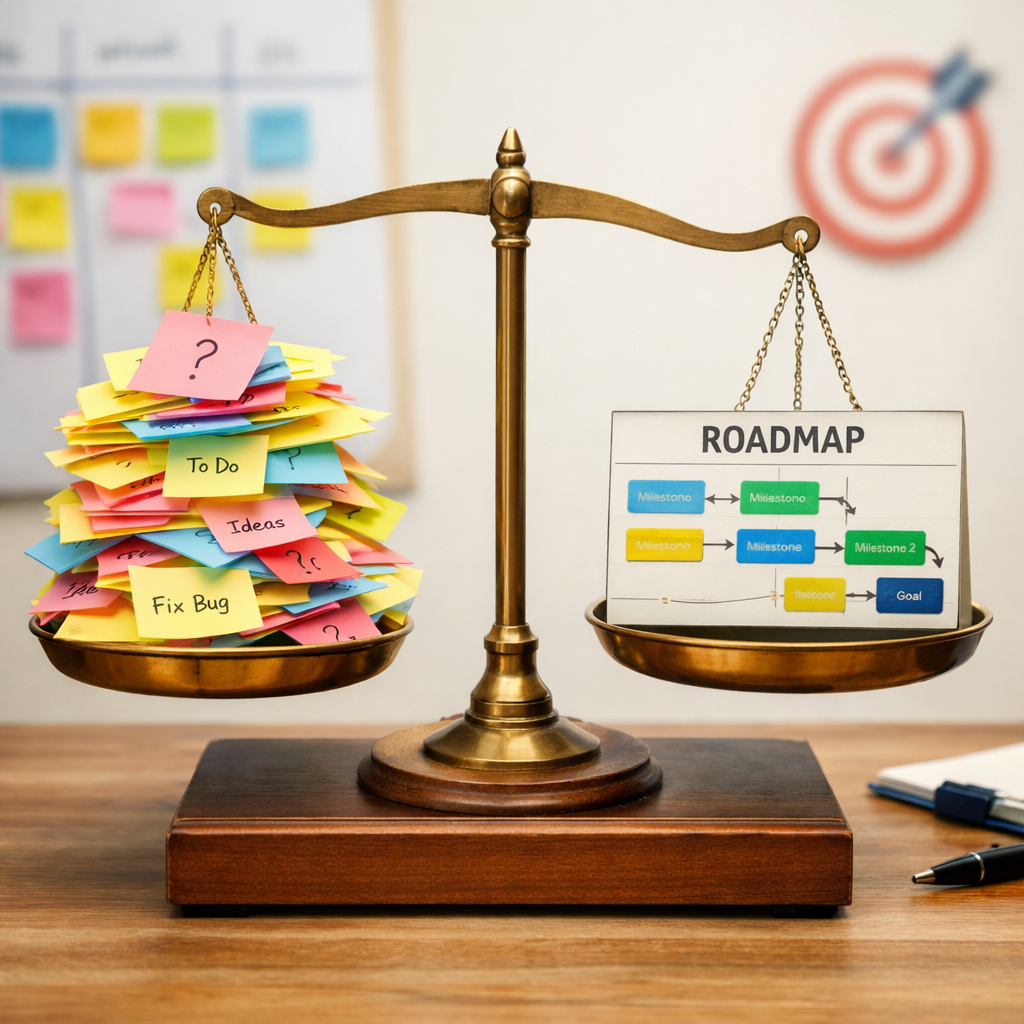
One of the most common tensions in Agile teams is this:
Should we keep adding ideas to the backlog, or should we protect delivery and keep lead time short?
Because let’s be honest…
Backlogs have a natural tendency to grow like that drawer in your kitchen where you throw “things that might be useful someday.”
Before you know it, your backlog has hundreds of items, half of which nobody remembers adding.
Meanwhile, your roadmap still promises a milestone in three months.
So how do we balance continuous discovery with iterative delivery without turning the backlog into a museum of forgotten ideas?
Let’s talk about it.
The Backlog Trap
In theory, Agile encourages continuous learning and idea generation.
Stakeholders bring new opportunities.
Customers reveal new needs.
Teams discover better solutions.
So naturally, new items get added to the backlog.
The problem begins when adding becomes easier than deciding.
Soon you get:
- Massive backlogs
- Long lead times
- Planning sessions that feel like archaeology
- Teams overwhelmed by “priorities”
At that point, the backlog stops being a decision tool and becomes a storage system.
And Agile was never meant to be a storage system.
The Roadmap Illusion
On the other hand, many organizations try to fix this problem by doing the opposite.
They freeze scope and create a very detailed roadmap months ahead.
This might feel reassuring because it gives the impression of control:
“We know exactly what we will deliver in Q3.”
But reality usually intervenes.
Markets shift.
Customers change behavior.
Technology surprises us.
Suddenly the roadmap becomes a promise we are afraid to break, instead of a direction we are trying to reach.
The Balance: Direction Without Overcommitment
The sweet spot is somewhere in between.
Agile teams need:
A clear direction (milestones)
without losing
the ability to adapt (iteration).
Think of the roadmap as a compass, not a GPS.
A compass tells you where north is.
It does not force you to walk in a straight line through the forest.
Milestones should provide outcomes, not a fixed list of features.
For example:
Instead of saying
“Deliver Feature A, B, and C in September”
Say
“Enable customers to complete onboarding without support.”
Now the team can still iterate and adjust while moving toward the milestone.
Keeping the Backlog Healthy
A few simple practices help keep the balance.
1. Treat the Backlog Like a Fridge, Not a Warehouse
A fridge contains what you realistically plan to consume soon.
If something stays there too long, you throw it away.
Backlogs should behave the same way.
If an item has been sitting there for months without discussion, it is probably not that important.
Archive it.
2. Keep the Backlog Short
A healthy backlog usually contains a few sprints or a few months of work, not years.
If the backlog looks like a product strategy document, it is too big.
Long backlogs increase lead time to decision, which slows teams down.
3. Separate Discovery from Delivery
Ideas should not immediately become backlog items.
Create a discovery space where ideas live until they are validated.
Only when an idea becomes realistic and valuable should it enter the backlog.
This keeps the backlog focused on things that might actually be built.
4. Plan Milestones, Not Everything
Roadmaps should focus on key milestones or outcomes.
Everything else should remain flexible.
Teams can then iteratively discover the best path to reach those milestones.
Agile Is About Flow, Not Storage
At the end of the day, Agile is not about how many items we manage.
It is about how smoothly value flows from idea to customer.
When backlogs grow too large, flow slows down.
When roadmaps become too rigid, learning stops.
The real art of Agile planning is keeping both direction and adaptability alive.
Not an easy balance.
But definitely worth mastering.
 Agile for All
Leave a comment