Most Agile Leads focus on events.
- A slow sprint
- A missed commitment
- A team complaining about dependencies
- A velocity drop
- A blocker that “suddenly” appeared
A system-thinking Agile Lead focuses on something else entirely:
The system that created those events.
And that’s what makes you special.
Not louder.
Not more controlling.
Not more “by the book”.
But deeper.
Agile Without System Thinking Is Just Local Optimization
When we don’t think in systems, we tend to:
- Push the team to “estimate better”
- Ask for “more commitment”
- Compare velocity across teams
- Speed up one step while slowing down three others
The result?
- Short-term improvements
- Long-term frustration
- Numbers that look good but feel wrong
System thinking shifts the question from:
“Why is the team slow?”
to
“What in our system makes this the only possible outcome?”
That single shift changes everything.
Seeing the Team as a Living System (Not a Task Factory)
A team is not:
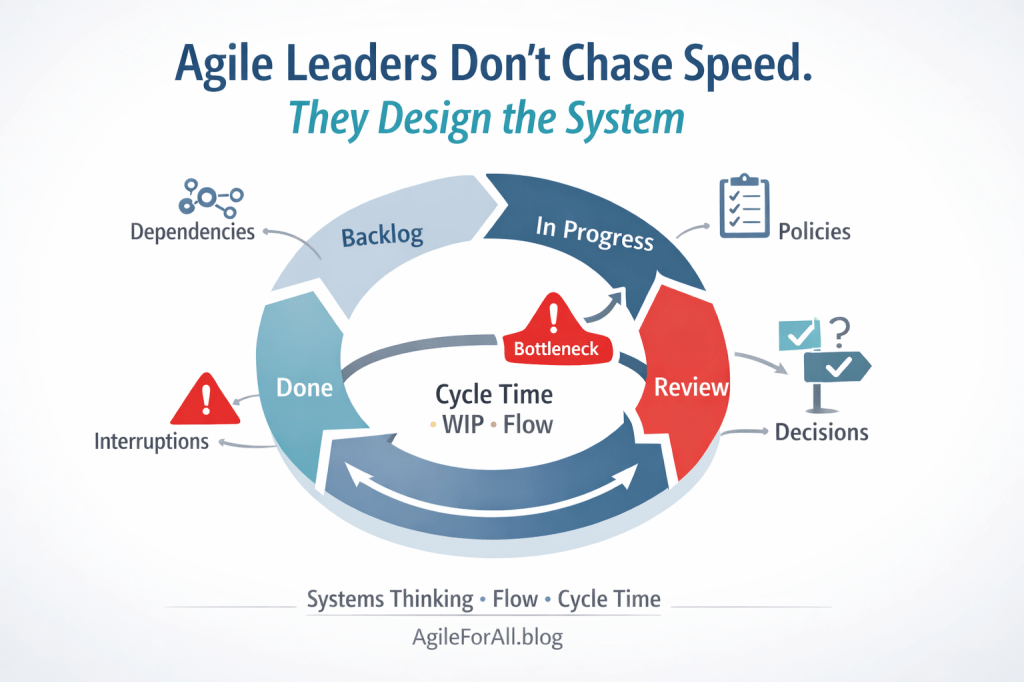
- Backlog → Sprint → Done
A team is a living system made of:
- People
- Policies
- Dependencies
- Tools
- Feedback loops
- Work types
- Interruptions
- Emotional and cognitive load
As an Agile Lead, when you start seeing patterns instead of incidents, you unlock a new level of impact.
You stop reacting.
You start designing.
Cycle Time: The Truth Teller of Your System
Velocity tells you how much work was completed.
Cycle time tells you how work actually flows.
A system-thinking Agile Lead knows:
- Long cycle time ≠ lazy team
- High variance ≠ bad estimation
- Blocked items ≠ poor planning
They usually mean:
- Hidden queues
- Too many handoffs
- Work started too early
- Dependencies introduced too late
- Context switching built into the system
Instead of asking:
“Why did this story take so long?”
You ask:
“Where did the system force this story to wait?”
That’s where real improvement begins.
Velocity Becomes a Signal, Not a Target
Velocity is useful, until you worship it.
System thinkers treat velocity as:
- A trend, not a goal
- A reflection, not a promise
- A system output, not a team KPI
When velocity drops, a system-thinking Agile Lead doesn’t panic.
They investigate:
- Was work sliced differently?
- Did unplanned work increase?
- Were there more dependencies?
- Did WIP increase?
- Did decision latency grow?
Velocity becomes a conversation starter, not a performance weapon.
Bottlenecks Don’t Live Where You Think They Do
Here’s the mistake many teams make:
They try to “fix” the slowest person or step.
A system-thinking Agile Lead knows:
Bottlenecks live in relationships between steps, not in people.
Common hidden bottlenecks:
- Reviews batching at the end
- External approvals
- Environment availability
- Knowledge silos
- One person acting as a decision gateway
By looking at the system end-to-end, you stop fixing symptoms and start removing constraints.
The Circular Improvement Loop (Not Linear Fixes)
System thinking replaces linear improvement with a circular learning loop:
- Observe flow (cycle time, queues, aging work)
- Identify constraints (where work waits)
- Adjust the system (policies, WIP, slicing, ownership)
- Measure again
- Learn and adapt
No “one-time fix”.
No “best practice rollout”.
Just continuous, contextual learning.
You Start Coaching the System, Not Just the Team
This is where you truly stand out as an Agile Lead.
You start influencing:
- How work enters the system
- How much work is allowed at once
- How decisions are made
- How dependencies are surfaced
- How feedback loops are shortened
You stop being “the Scrum ceremony owner”
and become the system designer and sense-maker.
That’s rare.
And incredibly valuable.
Why This Makes You Special as an Agile Lead
Because:
- You don’t blame people; you redesign systems
- You don’t chase speed; you improve flow
- You don’t optimize locally; you think end-to-end
- You don’t fight metrics; you understand them
System thinking turns Agile from a framework into a capability.
And Agile Leads who master this?
They don’t just help teams deliver faster.
They help organizations think better.
Closing Thought
If Agile is about adaptation,
then system thinking is the skill that makes adaptation possible.
And that’s what truly differentiates an Agile Lead.
 Agile for All
Leave a comment