Ever found yourself explaining something to a teammate and realizing you’re not just from different roles, but from different worlds?
One says “let’s email the client,” another says “let’s create a Slack channel,” and a third already made a Miro board before you even finished your sentence.
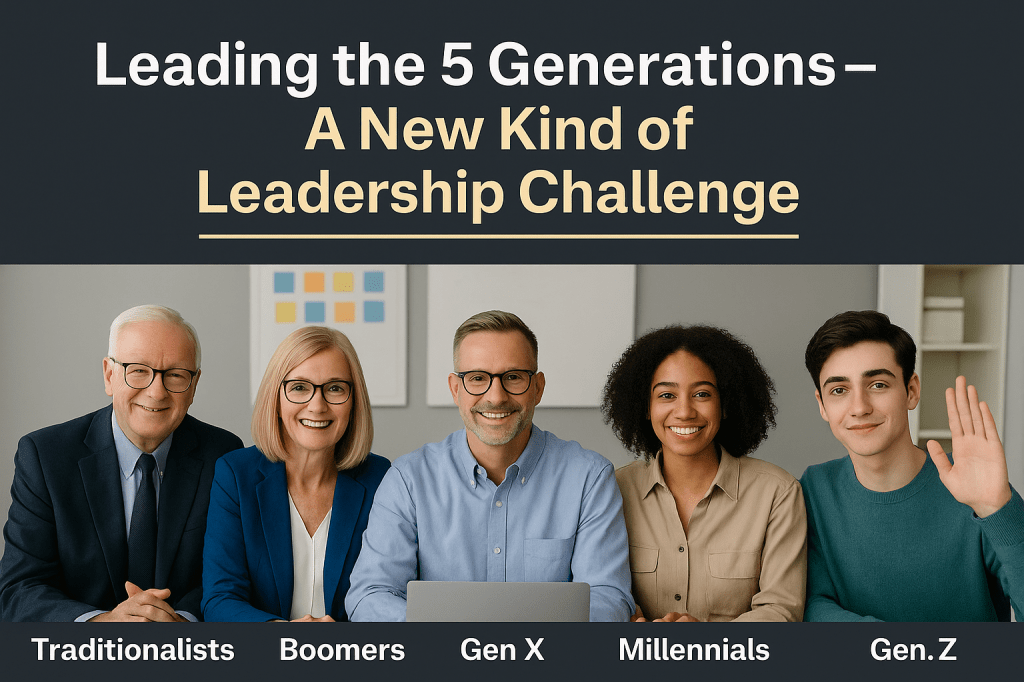
Welcome to today’s workplace: a fascinating mix of five generations working side by side.
It’s not just age. It’s five different timelines of experiences, habits, and expectations, all trying to collaborate in one sprint.
This topic fascinated me so much that I even built a session around it for our teams, and the discussions that followed were eye-opening. The laughter, the “aha” moments, and even the gentle debates showed how real these generational patterns are inside Agile environments.
Meet the 5 Generations (and What Drives Them)
Every generation has its own “default settings” the way they see work, purpose, and success.
- Traditionalists (born before 1946) – Think handwritten notes, handshakes, and lifetime careers. If it’s not broken, don’t fix it.
- Baby Boomers (1946–1964) – The loyal builders. They’ve seen the rise of color TV and cloud computing. Love a good meeting (in person, please).
- Generation X (1965–1980) – The bridge generation. They remember dial-up but mastered smartphones. They value independence — “Just tell me the goal, I’ll handle the rest.”
- Millennials (1981–1996) – Fluent in Wi-Fi and purpose. They’ll question why before they do what. Need flexibility more than fancy titles.
- Generation Z (1997–2012) – Born connected. Can text, brainstorm, and design a meme at the same time. Value balance, authenticity, and inclusivity.
Now imagine them all in one retrospective. Someone’s taking notes on paper, someone is updating ADO live, and someone is asking if this meeting could have been an emoji reaction.
That’s where the fun and the leadership challenge begins.
So, How Can Leaders Adapt?
Leading a multigenerational team isn’t about treating everyone equally, it is about treating everyone fairly based on what helps them shine.
- Adapt communication.
Some love long, detailed emails. Others want quick pings or GIFs. The secret? Mirror their preference. (If you’re replying to a Gen Z with a three-paragraph message, don’t be surprised if they respond with “👍.”)
- Blend experience with innovation.
Pair your most experienced team members with your most curious ones. Let wisdom meet experimentation. A Traditionalist’s patience plus a Gen Z’s speed can do wonders for a sprint review.
- Rethink feedback.
Boomers may see frequent feedback as “Are you doubting me?”, while Millennials may see silence as “Am I invisible?”. Schedule feedback rhythms that keep both trust and momentum.
- Model learning agility.
Nothing earns respect across generations like saying, “Teach me.” When a leader joins a Miro board for the first time or tries a new AI tool, it signals humility and that learning is ageless.
How Teams Can Bridge the Gap
This isn’t just a leadership thing teams have to build their own Generational Intelligence muscle too.
Talk about your working styles.
Imagine if every new team member filled in a fun “User Manual” I prefer calls in the morning, I process feedback best after a day, emojis are fine, just not the dancing banana one.
A two-minute talk can save two months of misunderstandings.
Challenge stereotypes.
No, Gen Z isn’t always distracted. No, Boomers aren’t allergic to change.
Everyone has preferences, not limitations.
Celebrate diversity in rituals.
Let Boomers host a mentoring coffee chat, let Gen Z lead a meme retrospective, and let Gen X manage the chaos in between.
Make it visible that every generation has something to teach.
Beyond IQ and EQ , Welcome to GI
For years, we have measured IQ (how we think) and EQ (how we feel).
Now, it is time to measure GI Generational Intelligence: how we understand and work with people shaped by different eras.
GI is the ability to notice not just what someone says, but why they say it that way.
It’s reading a meeting room (or chat thread) and knowing, “Ah, that silence means reflection not disagreement.”
Leaders with high GI know when to text, when to talk, and when to just listen.
They don’t get stuck in “my way or their way” they build our way.
The Agile Lesson in All This
Agile thrives on collaboration over control and individuals over processes.
And what better test of that than a team of five generations trying to agree on sprint goals?
The diversity that sometimes slows us down is actually what makes us stronger, as long as we stay curious, respectful, and adaptive.
After all, “responding to change” doesn’t just mean customer feedback, it means responding to each other’s worlds.
Final Thought
Leading across five generations isn’t a challenge, it is a superpower in disguise.
It teaches empathy, listening, and the art of translating between timelines.
If IQ makes you smart, and EQ makes you kind, GI makes you wise.
And in today’s fast, hybrid, human workplace that is the kind of intelligence leaders need most.
 Agile for All
Leave a comment