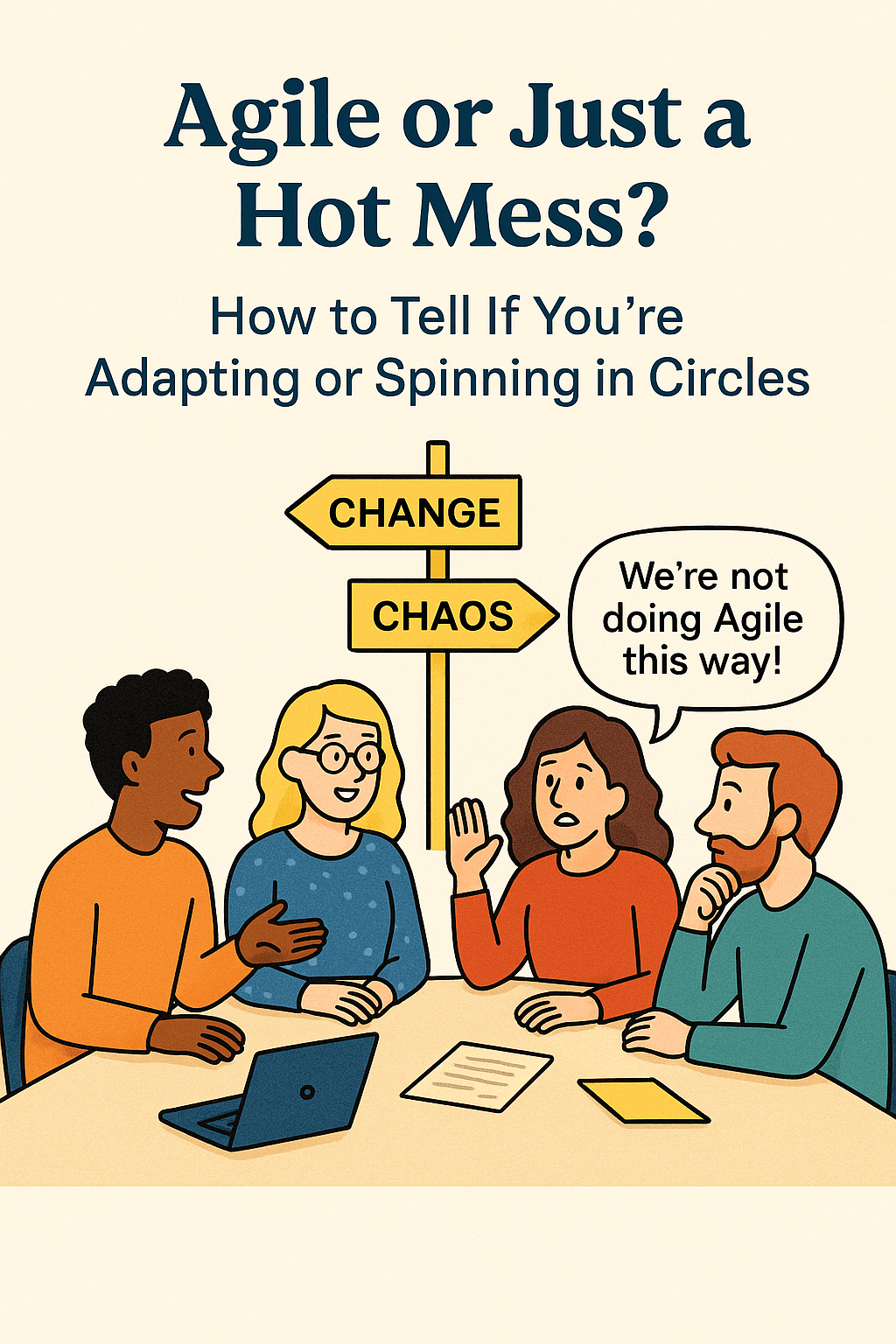
“We’re not doing Agile this way!”
If I had a coffee for every time I heard that in a retro, I’d be permanently buzzed. Let’s be honest—sometimes, “Agile” gets blamed when things feel off. But being Agile doesn’t mean throwing out all structure and winging it. That’s not Agile. That’s chaos… with a stand-up meeting.
Let’s talk about how to spot the difference between true agility and accidental mayhem.
1. Adapting Doesn’t Mean Ditching the Plan
Yes, Agile says “welcome change” but it never said “forget your entire plan and YOLO your sprint.”
Agile adapting looks like:
- Making thoughtful trade-offs when business priorities shift.
- Talking with the PO before adding or removing anything mid-sprint.
- Saying “okay, let’s adjust,” not “let’s panic.”
Agile chaos looks like:
- New “urgent” tasks popping in like surprise party guests.
- Nobody remembering what the sprint goal was (or if we even had one).
- Every retro starting with “well, we didn’t get to that…”
If your sprints feel like plot twists in a reality show, it might be time to pause and re-align.
2. Planning Is Still a Thing, I Promise
Agile doesn’t mean “no planning.” It means smarter, bite-sized planning that actually makes sense in a fast-changing world.
Good Agile planning =
- Having clear, achievable sprint goals.
- Knowing your team’s capacity (no more “we’ll try to finish 17 stories!”).
- Leaving some breathing room for surprises.
Fake-it-til-you-make-it chaos =
- Sprint boards changing like weather apps.
- No one knows what’s happening, but everyone’s really busy.
- The team motto is: “Let’s just start and see where we land.”
Spoiler: You’re likely to land in the land of undone work.
3. Change Is Fine If We Talk About It
Things change. Welcome to life, product development, and your favorite streaming app’s homepage. But change without context turns your team into firefighters instead of value creators.
Here’s a pro move:
Get your engineering or delivery manager to talk directly to the team when things shift.
- Let them share the why, the urgency, the bigger picture.
- After the change rolls out, show the impact. Celebrate how the team helped save the day (or delight the user, or unblock sales, or whatever awesome thing they just made possible).
People don’t mind change what they hate is feeling like chess pieces instead of collaborators. So close the loop. Let them see the value of what they just flexed for.
Oh, and while we’re here:
Agile is not a universal dress code.
Each team is its own flavor. Not every squad needs the same ceremonies, same velocity charts, or same meeting madness. Work the Agile principles your way as long as it’s working for you.
4. Transparency Is the Secret Sauce
You know what makes adapting way easier? Clarity. Transparency. No behind-the-scenes power plays or mysterious scope changes.
If your team says “Wait … when did we decide that?”ding ding ding! Time to up the transparency game.
Even a sticky note on Slack that says, “Hey, heads up! Business shift coming we’ll chat in tomorrow’s stand-up” can save a ton of stress and confusion.
5. Are We Actually Delivering Value? (The Litmus Test)
If you’re not sure whether you’re being agile or just running in circles, ask this:
Are we delivering real value, at a sustainable pace, that the customer or business actually needs?
If yes congrats!
If not maybe it’s not agility, it’s just noise in a sprint-shaped container.
Final Thought: Agile Isn’t Always Comfortable And That’s OK
Being Agile doesn’t mean being cozy all the time. Change is uncomfortable. Growth is messy. But it doesn’t have to be chaotic.
So next time someone says, “This doesn’t feel Agile,” take a breath and ask:
- Are we learning?
- Are we improving?
- Are we still a team?
If yes you’re doing just fine.
And if not … well, let’s talk about it. That’s what retros are for, right?
 Agile for All
Leave a comment