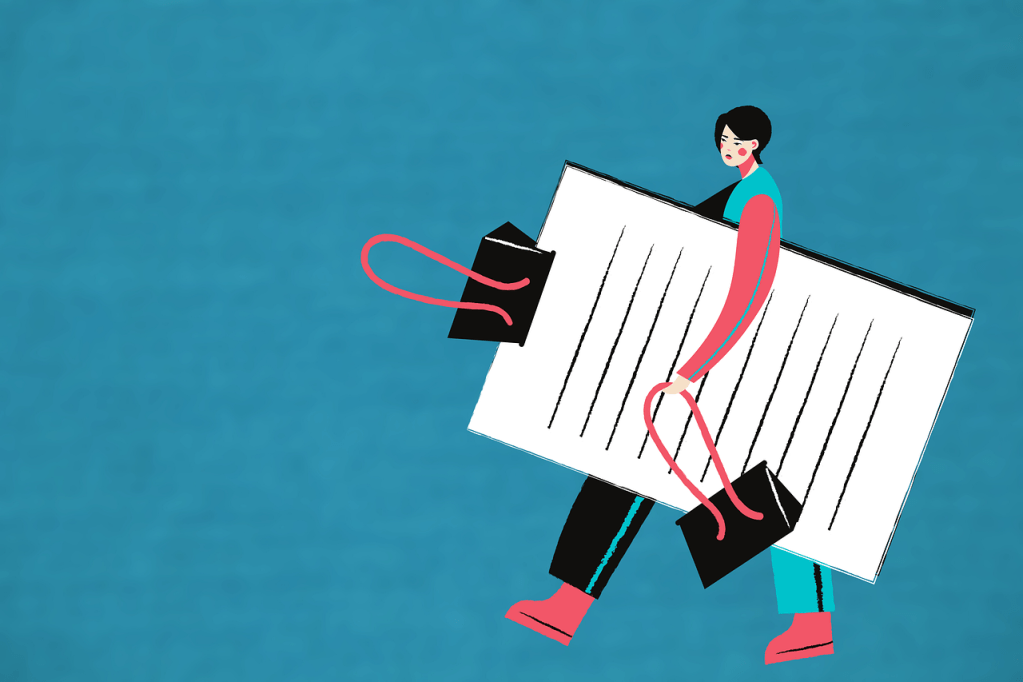
The Agile Manifesto says:
“While we value comprehensive documentation, we value working software more.”
But what happens when you’re not just a team of 7 but an ART of 100+? Suddenly, that one shared whiteboard sketch isn’t cutting it, and “over-documenting” feels like a survival instinct.
In SAFe, where we’ve got Agile Release Trains (ARTs) zooming across multiple teams, you might wonder: How much documentation do we actually need? Or better yet, how much is too much?
Let’s explore this question—with a pinch of humor and some real-life scenarios.
The Agile Manifesto and Documentation
Agile isn’t about rejecting documentation outright. It’s about valuing working software more. However, when scaling up to SAFe, the complexities of large-scale coordination bring unique challenges:
• How do teams communicate dependencies?
• How do we ensure everyone on the ART is aligned?
• How do we provide clarity without drowning in documentation?
Let me give you an example
Imagine your ART is tasked with building a chair.
• Team A is responsible for the legs.
• Team B is designing the seat.
• Team C is making the backrest.
Team A decides documentation isn’t necessary. After all, “Agile is about conversations, not paperwork!” So, they make legs that are 16 cm tall. Team B builds a seat fit for a barstool. Team C crafts a backrest that looks like modern art (but doesn’t connect to anything).
Congratulations, you’ve got three “working” components—and zero chairs.
In a scaled Agile setup, skipping documentation can turn collaboration into chaos. But let’s not go overboard either, or we’ll end up with “The Complete History of Chairs: Volume 1.”
When Documentation Becomes Overkill
• The 50-Page PI Plan: By the time you’ve read it all, the PI is over, and half the details are irrelevant.
• Confluence Gone Wild: A repository so packed with meeting notes, diagrams, and “action items” that it’s impossible to find the one thing you need.
• Dependency Charts from Hell: Lines connecting every team to every other team; so tangled it looks like spaghetti.
Finding the Right Balance
Here’s how to keep documentation helpful without letting it take over:
• Document the Basics: Instead of a 10-page manual for the chair, try:
• “Legs: Height = 45 cm.”
• “Seat: Width = 50 cm.”
• “Backrest: Connect to seat at 90° angle.”
Done. Everyone’s on the same page, and no one needs a PhD to figure it out.
• Focus on Living Documents: Make it easy to update and relevant. Nobody wants to read outdated instructions for something that’s already changed.
• Talk More, Write Less: Sometimes, a quick meeting or a Slack thread can do the job better than a detailed report. Agile is about communication, after all!
The Role of Documentation in SAFe
In SAFe, documentation plays a supportive but essential role. Here’s why:
- Alignment Across Teams: With multiple teams working together, documentation ensures shared understanding and helps avoid duplication of effort.
- PI Planning and Transparency: ARTs rely on clear plans and artifacts, such as backlogs, roadmaps, and dependencies, which require some level of documentation.
- Compliance and Governance: For industries with strict regulatory requirements, documentation becomes non-negotiable.
The Key Is Lean Documentation
While SAFe emphasizes coordination, it also promotes Lean principles:
• Document only what is necessary.
• Keep documentation concise and relevant.
• Use visuals, such as roadmaps and diagrams, to minimize lengthy text.
How Much Weight Should Documentation Have?
Documentation in SAFe is like seasoning in a dish—it enhances but shouldn’t overpower. Here’s how you might weigh it:
- Start with the End in Mind: Define the purpose of documentation for each stage (PI Planning, sprint retrospectives, etc.).
- Balance with Collaboration: Over-documentation can hinder collaboration and agility. Let face-to-face communication or virtual huddles do the heavy lifting.
- Evolve It: Like software, documentation should be iterative. It doesn’t need to be perfect from day one.
Practical Tips for SAFe Teams
• Use tools like Confluence or Miro for collaborative and dynamic documentation.
• Focus on living documents that evolve with the project.
• Foster a culture where documentation supports rather than stifles creativity.
Conclusion
In SAFe, documentation holds more weight than in smaller Agile teams, but it should never outweigh the value of working software. The goal is not to create reams of paperwork but to enable collaboration, alignment, and delivery. By keeping documentation lean and purpose-driven, SAFe teams can strike the perfect balance between Agile values and scaled needs.
 Agile for All
Leave a comment